


A New Chapter
The Renewal of a 1930s Listed Residence
Private
Residential
391 m2
Arid, Studio Thanasis
Athens, Greece
January 2025
Type
Program
Size
Collaborators
Location
Date

Dating back to the 1930s, this listed residence in Kypseli represents a distinctive example of the architectural heritage of the area. The design approach focuses on highlighting the building’s existing architectural identity and preserving the elements that convey its character and historical significance. The main façade retains its original form, colours and aesthetic, while authentic interior features are restored and brought back into focus, including the timber and cement-tile floors, plaster ornamentation and distinctive details of the common areas. Rather than treating the historic building as a static artefact, the intervention approaches it as a living part of the urban fabric, capable of continuing to evolve and accommodate contemporary life.

Inside, the new spatial arrangements aim to improve the functionality of the residences while preserving their underlying structure and distinctive character. Selective openings between rooms create greater spatial continuity and more generous living areas, while new partitions allow individual spaces to adapt to contemporary living requirements. The use of lightweight, clearly distinguishable construction systems minimizes intervention in the existing fabric, maintaining a careful balance between historic elements and new additions. The same approach informs the selection of materials and colours. Elements that carry the building’s historical memory are retained and restored, while contemporary interventions establish their own identity through more expressive colour and material choices. Rather than attempting to replicate the past, the design seeks a subtle dialogue between old and new, allowing each element to retain its own temporal and architectural character.
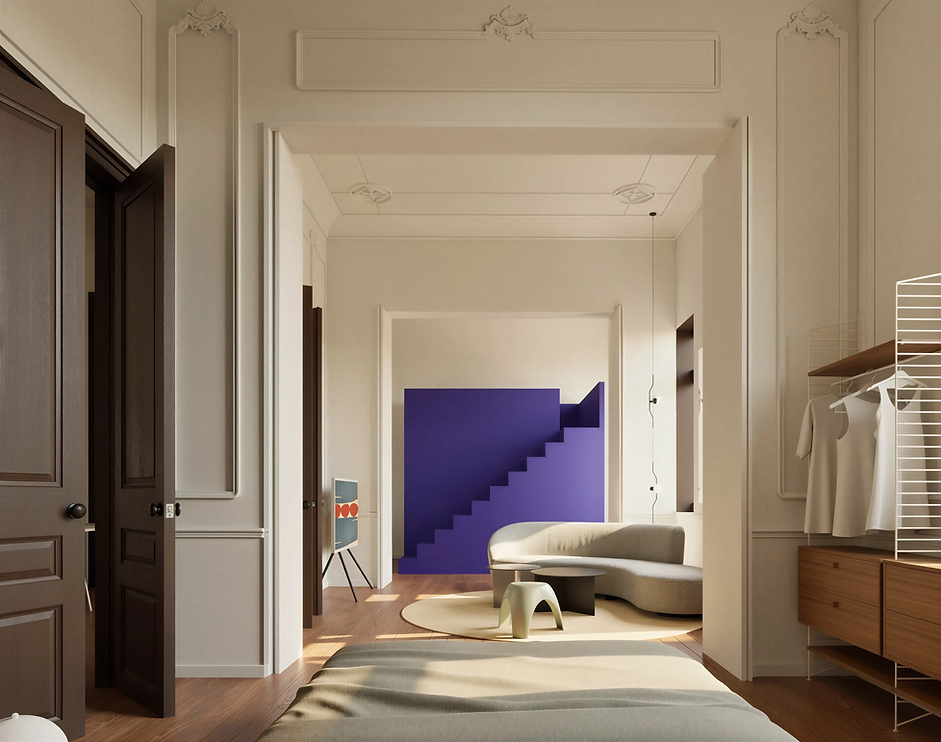


At the same time, the existing rooftop structure is adapted to accommodate a shared leisure space, introducing a new dimension to communal living and providing residents with an additional place for gathering and everyday use. This intervention reinforces the idea that restoration extends beyond preserving the building’s physical fabric to renewing the life it can accommodate. The project seeks to preserve the building’s architectural memory through a contemporary approach that respects its historical significance without disregarding the needs of the present. By restoring its authentic features and introducing new, distinct interventions, the building is given the opportunity to remain an active part of the city, retaining its character while redefining its relationship with contemporary living.
